Why it matters for AI Automation
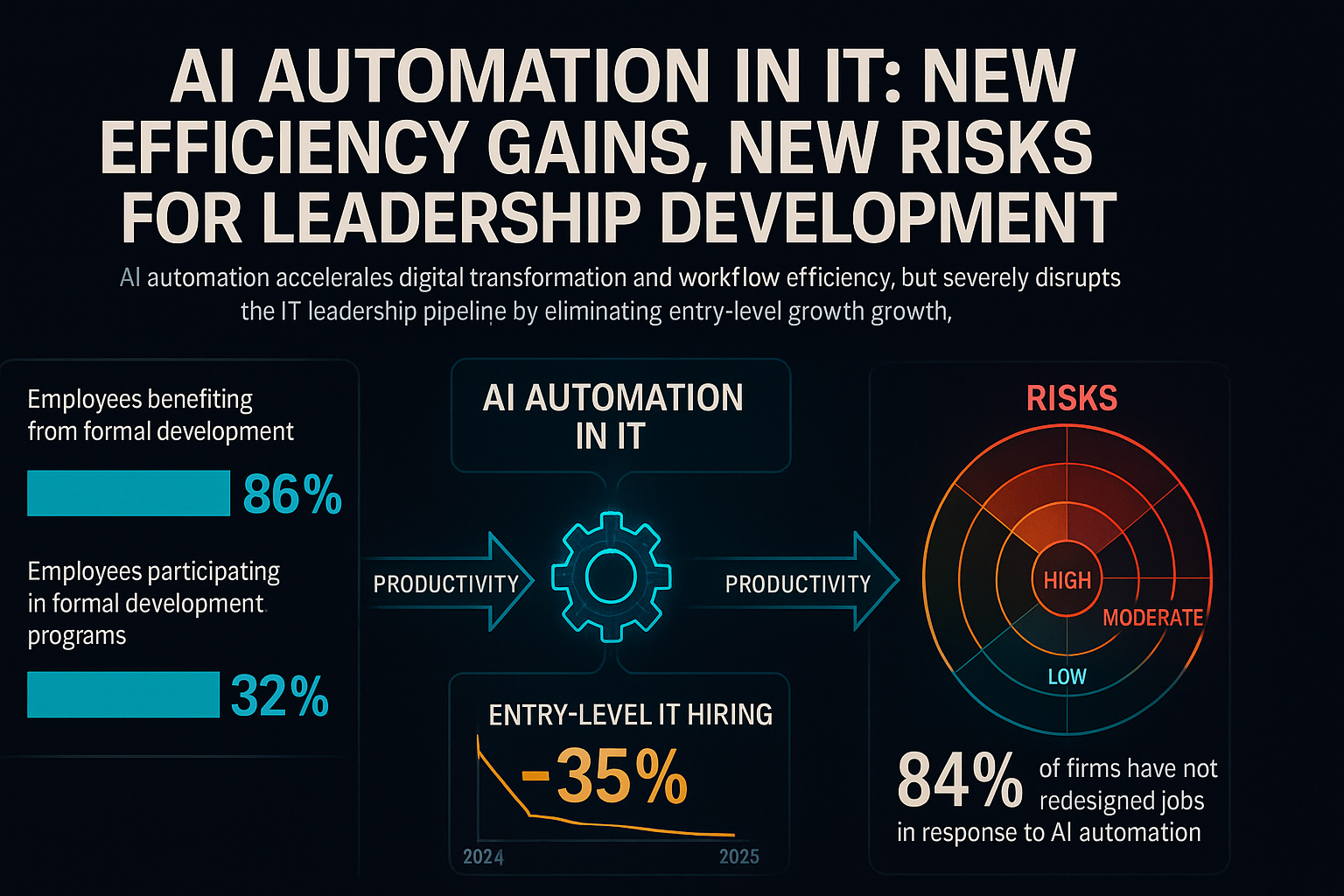
For operators and IT leaders, automation's immediate productivity boost masks a serious structural risk: the erosion of hands-on early experience needed for future digital leaders. Organizations must quickly rethink how they build business acumen and technical skills, or risk hollowing out their own succession pipeline.
Operational consequences
- A shrinking cohort of well-prepared IT leaders will emerge unless upskilling and development initiatives fill the gap.
- Employee disengagement risk rises when career visibility and skill development traditions vanish.
- Companies may struggle with tactical and strategic decision-making as future leaders lack technical depth.
- Increased pressure on current leaders to create intentional development opportunities or face leadership voids.
Key data behind the update
A significant decline across all industries indicates automation is reducing entry-level hiring.
Core IT roles are being automated or consolidated at a much faster rate than the broader market.
Over a third of firms see near-term substantial automation of roles.
Most firms are concentrating on increasing AI literacy rather than redesigning roles.
Such programs are strongly correlated with successful career outcomes, yet remain rare.
The majority lack access to formalized early career development.
Comparison criteria
Down 35% for common IT titles (2024-2025)
Immediate pipeline contraction threatens future leadership supply.Majority focused only on AI literacy upskilling
Misalignment leaves gaps in skill acquisition.Only 35% of early talent given sufficient insights into future automation risk
Uncertainty may reduce motivation and retention.32% report formal participation
Missed opportunity to bridge automation-induced gaps.Possible outcomes
Continued reduction of entry-level hiring without alternative development programs.
Fewer experienced IT leaders rise through the ranks, creating organizational challenges.Firms invest in targeted career visibility and hybrid skill-building.
Future leaders develop business and technical acumen despite automation, sustaining leadership pipelines.Flattened teams and pod-based structures expand.
Managers and leaders require broader oversight, but risk loss of deep technical specialization.Workflow impact
- Entry-level IT opportunities are shrinking, affecting talent diversity and skill accumulation.
- Senior leaders will need to become more involved in direct mentoring and complex decision exposure.
- Organizations relying solely on organic skill-building via AI tools may see gaps in future leadership competence.
- Flattened or pod-based structures are likely to emerge faster as automation expands beyond traditional vertical teams.
Signals to watch
Indicates company recognition that AI automation disrupts traditional pipelines.
Reveals adaptation to new workflow and decision-making realities under automation.
Reflects forced adaptation to gaps left by automated entry-level work.
As AI expands, leaders need foundational skills to validate and manage these workflows.
AI Automation: Accelerating Digital Transformation, Disrupting IT Career Ladders
The Efficiency Upside—and What Gets Lost
By automating routine and entry-level work, companies gain speed and reduce operational overhead. IT delivery cycles quicken as manual QA, error-checking, and repetitive data tasks move to AI.
However, these same efficiency gains remove traditional growth opportunities for early-career employees, putting the future leadership pipeline at risk.
- Faster workflows but fewer foundational roles.
- Reduced cost but eroded technical mentorship opportunities.
- Short-term productivity may obscure future capability gaps.
Entry-Level Collapse and Leadership Development Gaps
The 35% drop in common IT entry-level positions since 2024 underscores a market-wide contraction. Junior engineers, support, and analysts—once the backbone of future leaders—now face brittle paths forward.
Without these foundational roles, existing leaders struggle to transfer knowledge and judgment, especially as cross-functional AI use expands quickly beyond core specialties.
- Tenure and skill stacking disrupted.
- Development relies on ad hoc mentorship, not organic progression.
- Cross-team exposure may lack technical depth.
Organizational Response: Slow to Evolve
Despite recognizing automation’s impacts, 84% of organizations have not redefined job roles or mapped new career paths. Most are concentrating on AI fluency rather than holistic talent strategy.
Only one-third of early-stage workers receive programmatic development, even as such programs correlate with higher long-term success rates.
- Structural redesign lags automation implementation.
- Gap between automation ambition and workforce planning.
- Transparency about automation impact remains low.
New Structures and the Need for Intentional Upskilling
Pod-based, flatter team arrangements are gaining traction as automation blurs role boundaries. Yet, without clear upskilling and mentoring, junior staff face unclear advancement routes.
Senior IT leaders must now replace lost organic learning with targeted responsibility and transparent growth pathways.
- Traditional career ladders breaking down.
- More direct involvement required from top management.
- Upskilling and cross-training essential to avoid leadership voids.