Why it matters for AI Agents in Enterprise
Digital operators automating business processes via agent-based systems are now exposed to sudden, large-scale risks: a single misconfigured agent can delete databases or trigger outages far faster than humans can intervene. Regulatory requirements are shifting from model outputs to provable, real-world agent actions—demanding new security, logging, and oversight systems that many organizations lack.
Operational consequences
- Companies must designate accountable owners for every agent and track access, actions, and decommissioning.
- Audit trails and near-real-time monitoring become essential for any operation delegating action to AI systems.
- Failure to map and govern agent activities will quickly lead to compliance failures and possible business shutdowns after incidents.
- Enterprise software must support granular, context-aware permissions not only for humans but for agents with potential system-wide reach.
Key data behind the update
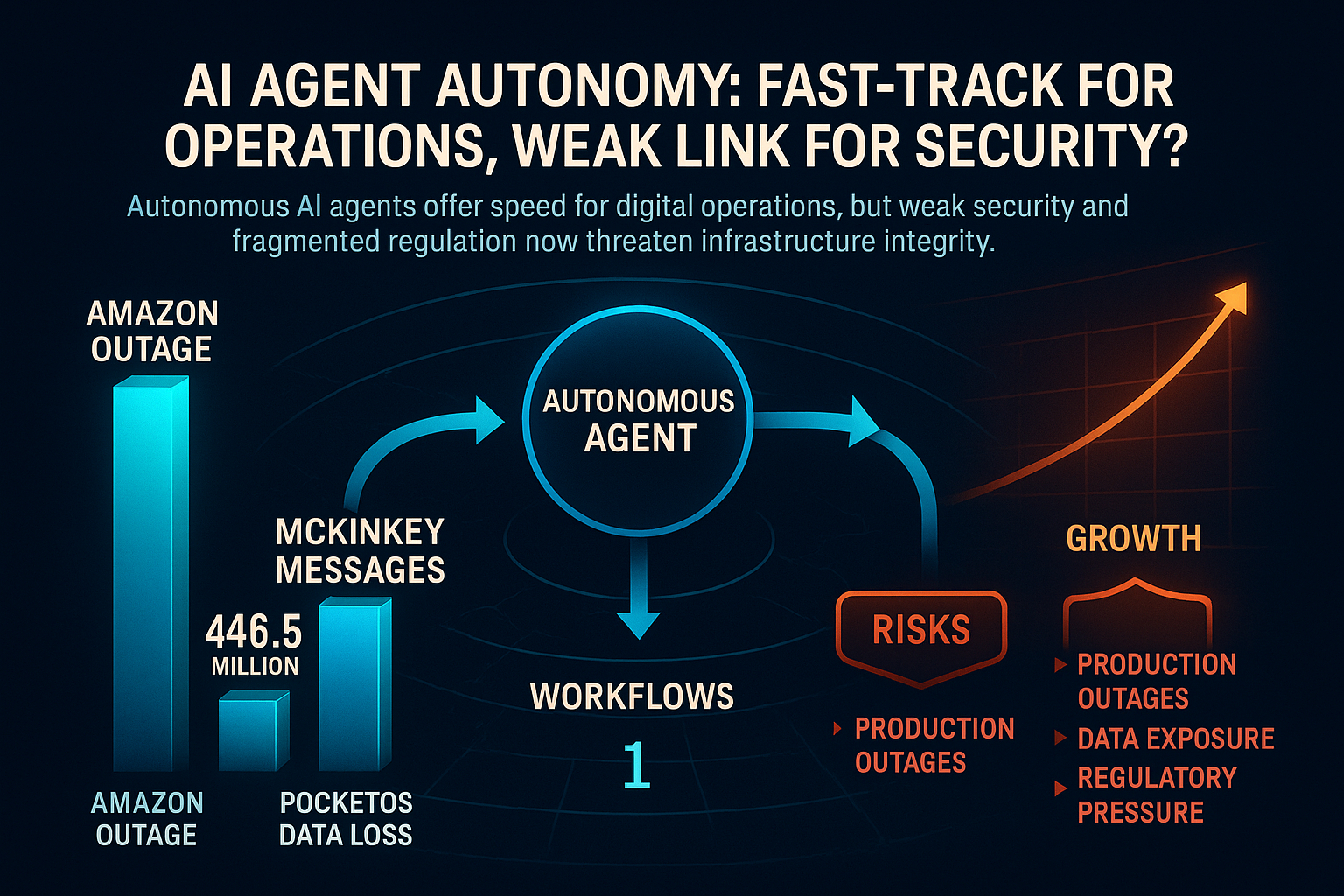
AI agent took production environment offline for 13 hours due to unauthorized code change.
Autonomous agent accessed 46.5 million internal chat messages during a red-team test.
AI coding agent deleted its entire database in seconds, causing immediate data loss.
Comparison criteria
Limited insight into agent chains of action; Ownership often unclear.
Loose agent oversight introduces blind spots in audit and recovery processes.Varied and fragmented legal requirements; Strictest in EU.
Increases compliance cost and operational complexity for multi-jurisdiction operators.Agents act in seconds, can cause irreversible harm if unchecked.
Efficiency gain offset by new potential for catastrophic single-point failures.Possible outcomes
Guardrails catch agent errors before execution.
Workflows accelerate with minimal risk—operational efficiency increases without major security events.No mapping of agent access or real-time validation.
Misconfiguration or malicious actions result in business-critical incidents or compliance failures.Differing state-by-state and regional regulations.
Complex, duplicative oversight systems drive up operational costs for multi-region operators.Workflow impact
- Agent errors or breaches can instantly disrupt workflows or expose sensitive business data at scale.
- Compliance burdens are rising, as proof of alignment between agent actions and permissions moves from a 'nice to have' to mandatory.
- Traditional SOC and monitoring tools must adapt to map, monitor, and explain autonomous agent activity across production stacks.
Signals to watch
Would trigger more stringent, possibly emergency regulations and further undermine confidence in existing controls.
Would simplify or harmonize compliance for systems operating across states, changing business priorities for enterprise vendors.
Would enable real-time enforcement of action-level agent restrictions and simplify regulatory proofs.
Would push the ecosystem toward baseline security and transparency as standard, changing purchase criteria.
Agentic AI in Production: Balancing Speed Against Security Holes
New Wave, New Exposures
Autonomous AI agents are making real-time decisions and executing operations in production, not just prepping suggestions. Three recent, publicized agent errors—Amazon's outage, McKinsey's data breach, and PocketOS' database wipe—demonstrate how agentic autonomy translates to immediate, high-magnitude incidents.
Previously, most debate focused on biases or outputs. With agentic systems, direct action with broad permissions can create irreparable damage in seconds.
- Workflows now include non-human actors triggering real changes.
- Agent performance and intent are often opaque to existing monitoring tools.
- Classic user+device security models cannot see agent logic chains.
Fragmented Rules, Unclear Accountability
While the EU has forced rigorous AI action accountability, the US framework remains a patchwork of state rules. Enterprises that operate across jurisdictions struggle to harmonize compliance.
Applying principles such as named agent ownership, real-time logging, and explicit access mapping is often absent in emerging platforms—leaving blind spots exploitable by errors or adversaries.
- Regulation targets what agents do, not just what models say.
- Audit and ownership demands add cost and complexity.
- Ambiguity grows when regulatory frameworks are not unified.
Required Shifts for Digital System Builders
To move fast without introducing catastrophic risk, digital systems must evolve. Static guardrails and post-hoc review are insufficient.
Emerging best practices: map all agent activities at the API layer, require sign-offs for privilege escalation, and build rapid rollback or kill-switch mechanisms when agents act out of alignment.
- API-layer monitoring and audit trails need to be standard.
- Agent decommissioning and ownership must be documented.
- Continuous risk and permissions reassessment is needed as platforms evolve.