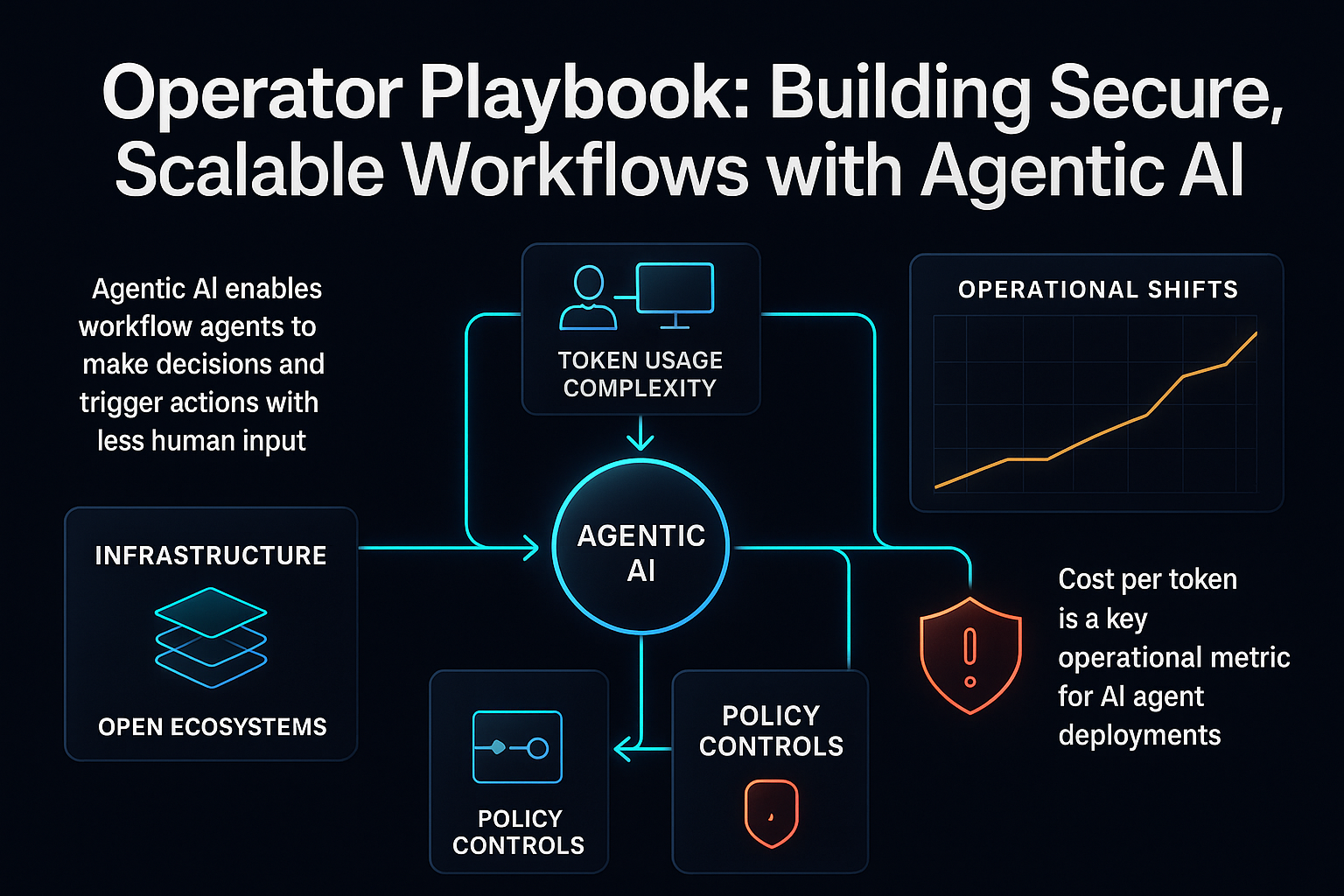
Operational Shifts: From Copilots to Agentic AI
QualitativeToken usage complexity
Deployment speed in open ecosystems
Workflow impact
- Workflows involving sensitive content or financial actions must upgrade their review and permissions policies.
- Teams gain momentum and reduce manual handoffs by letting agents coordinate and move tasks forward independently.
- Cost tracking shifts to 'tokenomics', with per-task, per-agent compute and data costs likely rising—especially as AI workflow scope widens.
- Data proximity and system integration determine the scale and reliability of agentic workflow automation.
Key data behind the update
Unlike copilots, agents do multi-step reasoning, tool calling, retries; Leading to unpredictable token consumption.
Guardrails must precede agent-initiated changes, especially those affecting permissions or financial operations.
Teams avoid lock-in and adapt to existing infrastructure, going from pilot to production quicker.
Workflow agents require trusted, real-time access to business data sources for context and compliance.
Operational consequences
- Failure to adapt permissions and oversight processes could expose operations to policy or compliance risks.
- Without cost and usage observability, agent-based workflows might overrun budgets or create unmonitored operational complexity.
- Siloed AI deployments risk lock-in; Open ecosystems are required for teams needing cross-platform integration.
- Legacy workflow tools may need upgrades or replacement to accommodate agentic AI models and runtime requirements.
Comparison criteria
AI agents act with policy-based boundaries and approval steps
Requires new review and permission models for agent-initiated activity.Flexible, open ecosystem required to connect multiple apps and data sources
Teams must audit and augment integration capabilities before agents scale.Token usage and per-agent activity must be tracked and forecasted
New monitoring and budgeting tools needed for real-world cost control.Agents require policy-based actions and log every workflow step
Audit trails and policy enforcement systems become mandatory.Signals to watch
Wider production use introduces new review and policy challenges at speed.
Token consumption, now a key infrastructure metric, will affect operating budgets.
Teams should track emerging best practices in agent security and data governance.
Teams with heterogeneous workflows will favor platforms that minimize lock-in and maximize flexibility.
Timeline
- Traditional automation
Enterprises relied on hardcoded, rule-based scripts and job schedulers, with limited context or cross-workflow activity.
- Next-generation copilots
LLMs and AI copilots provided content assistance; Remained within user tasks, no direct actions on workflow.
- Transition to agentic AI (2026)
Agents now coordinate, act, and decide on enterprise workflows, enabled by platforms like Dell AI Factory with NVIDIA.
Agentic AI: Practical Shifts for Video and Content Ops
Rethinking Workflow Oversight
AI agents move from supporting to executing workflow actions, including approval or financial operations. Every step they automate must be matched with new permission and review protocols.
Legacy review models may miss risks introduced by autonomous action. Teams must update oversight and traceability as AI steps out of the user-assistant role.
- Audit workflow actions enabled by agents before scaling.
- Move review checkpoints before agent-triggered financial or identity changes.
- Create audit trails for all agentic activities across systems.
Integrating for Speed and Scale
Open ecosystems save teams from vendor lock-in and let them connect agents to existing workflows and tools. This accelerates not only deployment but also adaption to fast-evolving business needs.
AI agent adoption demands integration flexibility: media, data, apps, and governance frameworks must interoperate.
- Map required integrations and data sources for each agent use-case.
- Ensure agent runtime supports all target workflow platforms.
- Test new deployments against compliance and data residency needs.
Tokenomics: The New Cost Center
AI agents execute multi-step tasks, retrieve context, and retry actions. This increases compute (token) usage, making cost and utilization visibility crucial in operations.
Teams face a learning curve on cost unpredictability—token budgets may shift wildly based on workflow design and complexity.
- Track per-agent, per-task token consumption for forecasting.
- Benchmark workflow costs before large-scale rollouts.
- Monitor for runaway token usage in new AI-driven tasks.
Governance and Security Foundations
The expansion of agentic AI makes enterprise security and policy enforcement non-optional. Secure runtimes (like OpenShell), permissioned data access, and constant observability are foundational.
Human-in-the-loop review remains essential for exception handling and oversight, especially when agents act across financial systems or sensitive content.
- Enforce identity, actions, and data limits by default.
- Log every agent action for early error/breach detection.
- Keep sensitive or regulated data out of lightly governed agent tasks.