Why it matters for Why 40% of Agentic AI Projects
Agentic AI is shifting from promise to practice in digital operations. Many companies risk wasted investment as project management, not technical hurdles, drives cancellation. Success requires clear outcome metrics, strict control, and transparency—critical factors for workflow leaders under pressure to deliver real automation ROI.
Operational consequences
- Wasted spend on unfinished or underperforming AI projects could harm IT credibility and future innovation budgets.
- Market 'agent washing' is likely to trigger both vendor shakeout and pushback from more skeptical buyers.
- Automation risks, including unmonitored actions and unseen errors in production, heighten the compliance burden.
- Companies lacking operational discipline in agent deployment may face public incidents, affecting brand trust.
Key data behind the update
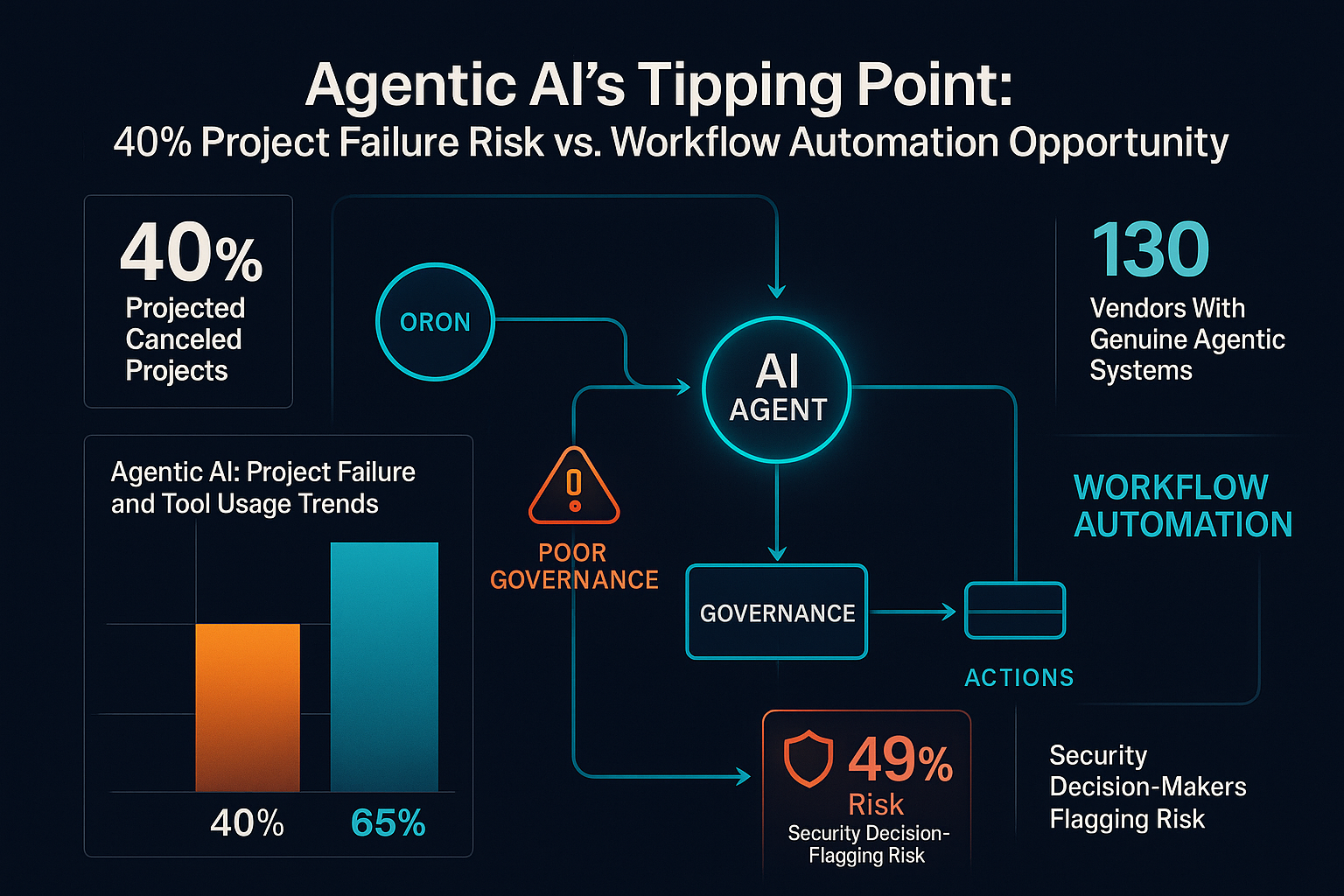
Gartner forecasts over 40% of agentic AI projects will be canceled by 2027.
By early 2026, 65% of agentic AI tool usage was for action tools, up from 24% in late 2024.
49% of security leaders consider autonomous agents a concern for enterprise security.
Of thousands of companies claiming agentic AI, only about 130 meet true autonomous deployment standards.
Comparison criteria
Governance, operational discipline, unclear metrics
Leadership attention must pivot from improving models to tightening managementThousands claim agentic AI; ~130 actually deliver it
Buyers must become more skeptical and evidence-drivenAction tools now dominate
Risk profile and required controls escalate sharplyPilots succeed, production deployments often fail
‘Verification gap’ demands new pre-production checksPossible outcomes
Companies implement strong control, success metrics, and integration discipline before going live.
Reduced risk of cancellation and increased long-term value from AI investments.Projects advance from pilot to production based on demos without clear metrics or access plans.
High risk of costly failures, project cancellations, or public errors due to unaddressed gaps.Workflow impact
- Operational investments in agentic AI may be written down if projects lack clear success metrics or governance.
- Vendors selling low-complexity AI in agentic packaging face exposure as the market matures and buyers demand proof.
- Security and compliance leaders will be increasingly called to vet AI's autonomy before integration with sensitive data.
- Organizations with mature operational discipline stand to consolidate gains as competitors' projects stall or fail.
Signals to watch
Could confirm Gartner's cancellation rate; Signals operational/human factors are breaking deployments.
Indicates the market acknowledges deployment risks and is pivoting to risk-first positioning.
Would validate concerns from security leaders and may spike regulatory or customer demand for controls.
May reveal best practices that separate successful operationalization from failed pilots.
Operational Gains, but Governance is the Gate
Why Most Agentic AI Deployments Break Down
Project failures are rarely caused by weak AI models. Instead, companies ignore governance and allow agents access to tools and data without agreed metrics or human controls.
The gap between pilot demos and production performance—often called the 'capability-deployment verification gap'—costs budgets and can convert a promising proof-of-concept into a long-term liability.
- Pilot success hides real integration and ownership gaps.
- Projects stall when data, accountability, or rollback plans are missing.
- Agent autonomy magnifies errors without strict oversight.
Who's at Risk—and Who Stands to Win
Vendors packaging simple automation as agents benefit in the short run but face loss of trust as failures mount. Organizations with operational maturity and explicit success criteria can build durable competitive advantages.
Security teams and compliance leads are becoming central to AI workflow review, moving beyond IT to board-level attention.
- Market shakeout will penalize superficial 'agent washing' vendors.
- Upside favors organizations mastering operational discipline.
- Security and compliance review extents are increasing rapidly.
What Successful Deployments Do Differently
Leading organizations now ask three fundamental questions before approving AI autonomy: what is the success metric, does the agent have required access, and who is responsible if the agent malfunctions?
Proactive risk planning is becoming the main stage in agent onboarding, rather than an afterthought.
- Tie every deployment to a business outcome and named owner.
- Explicit access and rollback plans for production agents.
- In-market, vendors are shifting sales messaging to governance.