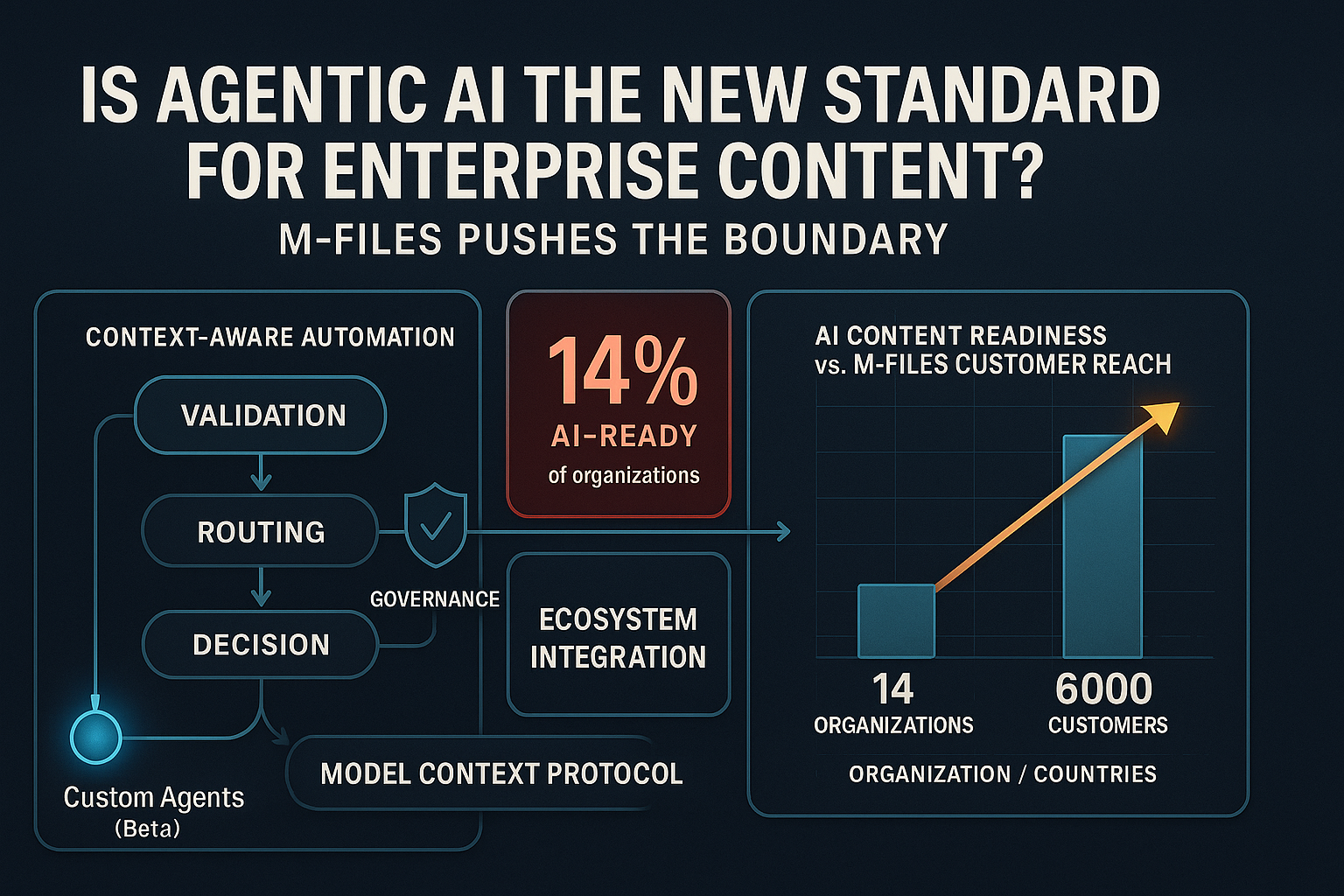
Key data behind the update
The vast majority of organizations lack confidence, highlighting the readiness gap.
Indicates M-Files’ pre-existing market reach for potential agentic AI deployment.
Points to the global surface area for agentic AI’s potential adoption via M-Files.
Why it matters for Agentic AI in Enterprise
As pressure mounts for operational efficiency, agentic AI offers enterprises a route to automated, auditable actions within workflows. However, unless organizations address the foundational challenge of AI-ready content, the transformative potential of agentic AI will remain limited to leaders with robust information architectures.
Context behind Agentic AI in Enterprise
Traditional enterprise automation relied heavily on deterministic, rule-based logic and required highly structured data. The emergence of LLMs and AI-driven assistants boosted discovery and retrieval, but most enterprises have not yet bridged the gap to full agentic automation—where systems make and document autonomous decisions based on context. The cited industry data (Gartner: 14% content AI readiness) shows the immaturity of the average enterprise’s information architecture, explaining why these agentic capabilities may disproportionately benefit more digitally mature organizations.
Workflow impact
- Could accelerate workflow automation for organizations already invested in data governance infrastructure.
- May force lagging companies to confront legacy content issues or risk falling behind in productivity gains.
- Drives demand for explainable, auditable AI action trails in regulated industries.
- Incentivizes ecosystem interoperability to increase AI agent utility across platforms.
Comparison criteria
M-Files automates actions only when content is AI-ready (supported by Enterprise Knowledge Graph).
Adoption is gated by readiness, not just availability.Agentic AI enables configurable, natural language-driven routing/validation.
Potential for leapfrogging legacy processes where readiness exists.Every agent decision is recorded with reasoning and source, enabling compliance.
Increased trust and adoption in regulated verticals.Emerging support for Model Context Protocol aims for broader agent interoperability.
Standardization may determine network effects and platform durability.Timeline
- June 24, 2026: M-Files launches Custom Agents (Beta)
Announcement positions agentic AI as key to automating document-centric processes.
- Ongoing: Development of Model Context Protocol (MCP) support
Signals commitment to interoperability and extending enterprise context to third-party AI platforms.
Signals to watch
M-Files is building support for Model Context Protocol—adoption indicates industry alignment.
Acceleration would validate market-wide intent to address AI readiness.
Would signal broader acceptance of M-Files’ governance-focused model.
What Changes with M-Files' Agentic AI?
Agentic Automation: Capability and Limits
M-Files’ Custom Agents integrate natural language AI into core business workflows, shifting from simple assistance to full process automation. Every action is governed by permission controls and recorded for compliance.
Current impact is constrained—organizations must possess both rich metadata and strong governance to unlock these capabilities.
- Automation covers validation, routing, and content-based actions.
- Explainable AI with auditable output is standard.
- Works atop existing content compliance structures.
Readiness Gap: The Market’s Bottleneck
The majority of enterprises lack confidence in their ability to support AI-ready content, according to Gartner’s 14% figure. Weak data foundations remain the chief barrier.
Without wide foundational improvement, agentic AI shifts will outpace general enterprise readiness.
- Low AI readiness stalls broad automation.
- Customer impact is greatest among digital leaders.
- Potential for increased market segmentation.
Ecosystem Moves and What to Track
M-Files’ support for Model Context Protocol points to future integration beyond its own platform—an essential precondition for network effects.
The industry will need to watch not just features, but growth in explainable, governed AI from other vendors.
- Interoperability standards could accelerate adoption.
- Cross-platform agent orchestration likely to become a differentiator.
- Auditability requirements may prompt regulatory and procurement shifts.