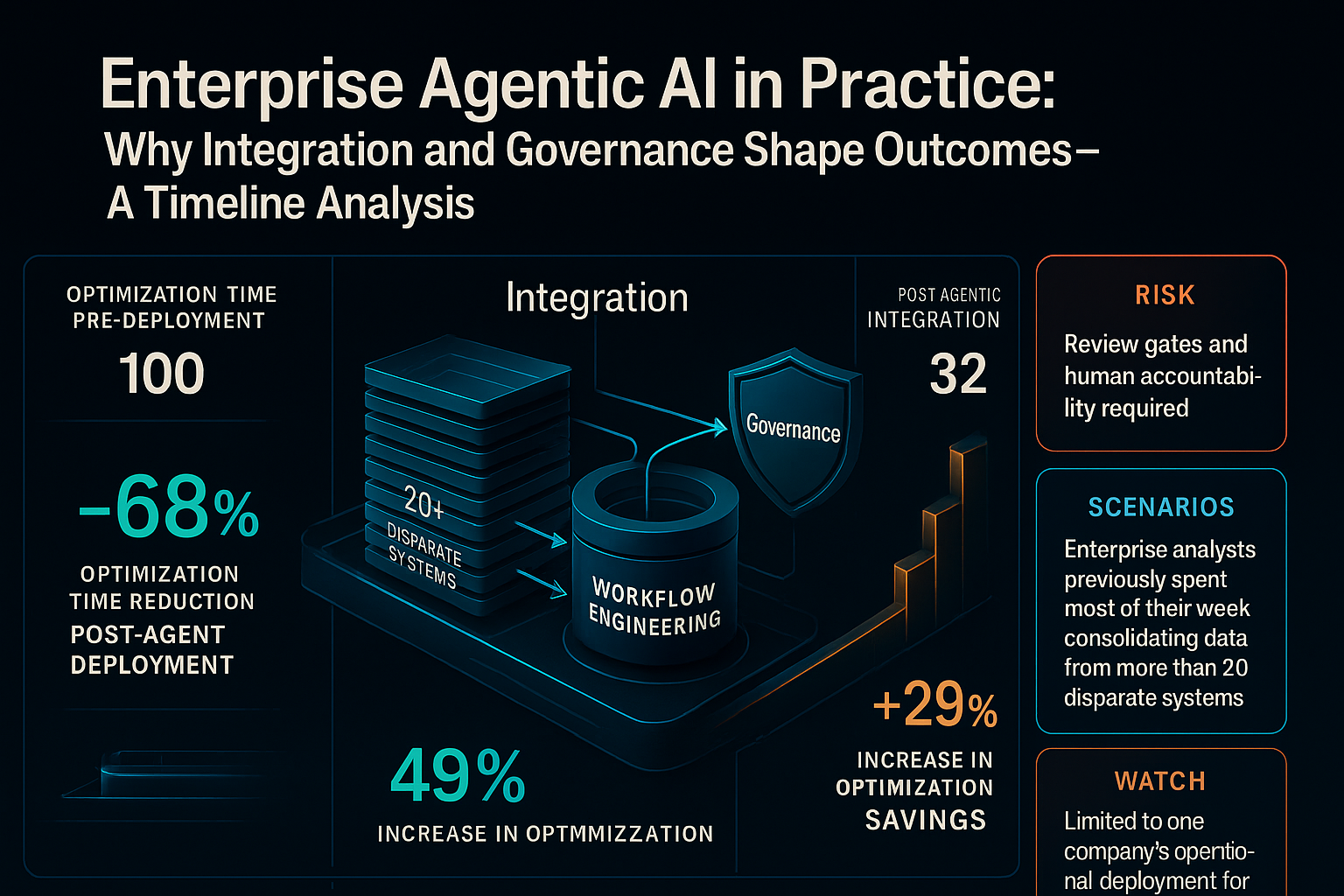
Agentic AI Enterprise Deployment: Integration and Outcome Milestones
Relative index (baseline=100)Timeline
- Prior 18 months
Market pushed agentic AI as end-to-end automation, ignoring integration and compliance hurdles.
- Enterprise deployments fail post demo
Projects stall when teams ignore underlying workflow and compliance complexity.
- Pragmatic engineering adoption
Successful teams embed agents as recommendation engines with built-in governance.
- Operational results
Notable deployment reduces optimization time by 68%, increases savings by 29%, shifting analyst focus to high-value tasks.
- Future checkpoint: Early compliance-first design
Watch for legal and compliance reviews at project start as a new standard.
Context behind Timeline
Over the past 18 months, a surge of agentic AI projects has targeted complex business workflows with the promise of hands-off automation. Yet, most large organizations cannot bypass legal, compliance, and change management hurdles—forcing teams to reconsider architecture after costly failures. Real-world outcomes show integration quality, human accountability, and compliance readiness matter more than AI benchmark scores in live operational settings.
Why it matters for Timeline
Digital operations and workflow leaders often invest heavily in AI pilots, only to encounter scale limitations unrelated to AI capability. Understanding why system architecture and compliance gating, not model performance, shape deployment readiness aids more predictable roadmap planning and ultimately enables sustainable adoption.
Key data behind the update
Agentic AI reduced workflow cycle time significantly through improved data and process orchestration.
Engineered integration delivered additional business value beyond mere speed gains.
Complexity lies in orchestrating data from over 20 siloed systems, not the mathematical model.
Comparison criteria
System designed for agent input/output in existing workflows
Core operations remain stable, deployment faster, fewer workflow breakagesHuman-in-the-loop gates and auditability from day one
Lower risk of regulatory or legal challenge, faster cross-unit approvals29% more savings, 68% faster cycles
Demonstrates value from orchestration, not just the agentPossible outcomes
Compliance steps added during or after deployment.
Project delays and increased costs; Potential legal or operational blockers.Architecture embeds review gates for human oversight from the start.
Faster sign-off, smoother operational handoff, and defensible audit trails.Signals to watch
Signals enterprise recognition of integration and governance as core success factors.
Indicates market movement toward deployable, auditable architecture.
Shows organizations are internalizing the cost of post-hoc compliance retrofits.
Demonstrates realignment of technical roadmaps toward sustainable operational AI.
Timeline: How Pragmatic Engineering Redefined Enterprise Agentic AI Outcomes
From Model Debates to Integration Failures
Early rollouts prioritized model selection, treating critical integration as an afterthought. Projects would pass initial demos, but then hit roadblocks as downstream systems failed to align or accept agent-generated changes.
- Integration seen as 'somebody else's problem' post-demo.
- System breakages occur when outputs disrupt interconnected operations.
- Legal and compliance issues multiply without built-in accountability.
Operational Results: Measuring Real Impact
In a documented case, automating the data prep and recommendation cycle shifted analyst focus to higher-value investigation. The project’s ROI appeared not in model choice, but in orchestrating fragmented systems into a cohesive workflow.
- 68% drop in optimization cycle time post agentic integration.
- 29% increase in realized optimization savings.
- Shift of analyst resources from data prep to oversight and review.
Why Retrofitting Compliance Slows Progress
Treating governance and review as bolt-ons causes higher costs and legal friction. Regulated sectors, in particular, block deployment if human decision gates and thorough auditability are absent from initial architecture.
- Delayed compliance reviews force re-architecture.
- Audit trails are expensive to add post-hoc.
- Human-in-the-loop allows for defensibility in audits.
Next Signal: Compliance and Engineering Upfront
Firms embedding governance and integration early show stronger progress; Watch for this in new enterprise AI rollouts.
Legal and compliance teams joining project kickoffs may indicate a maturing playbook—and more reliable timelines.
- Legal review at project start.
- Audit logging engineered from day one.
- Integration focus leads to lasting deployments.