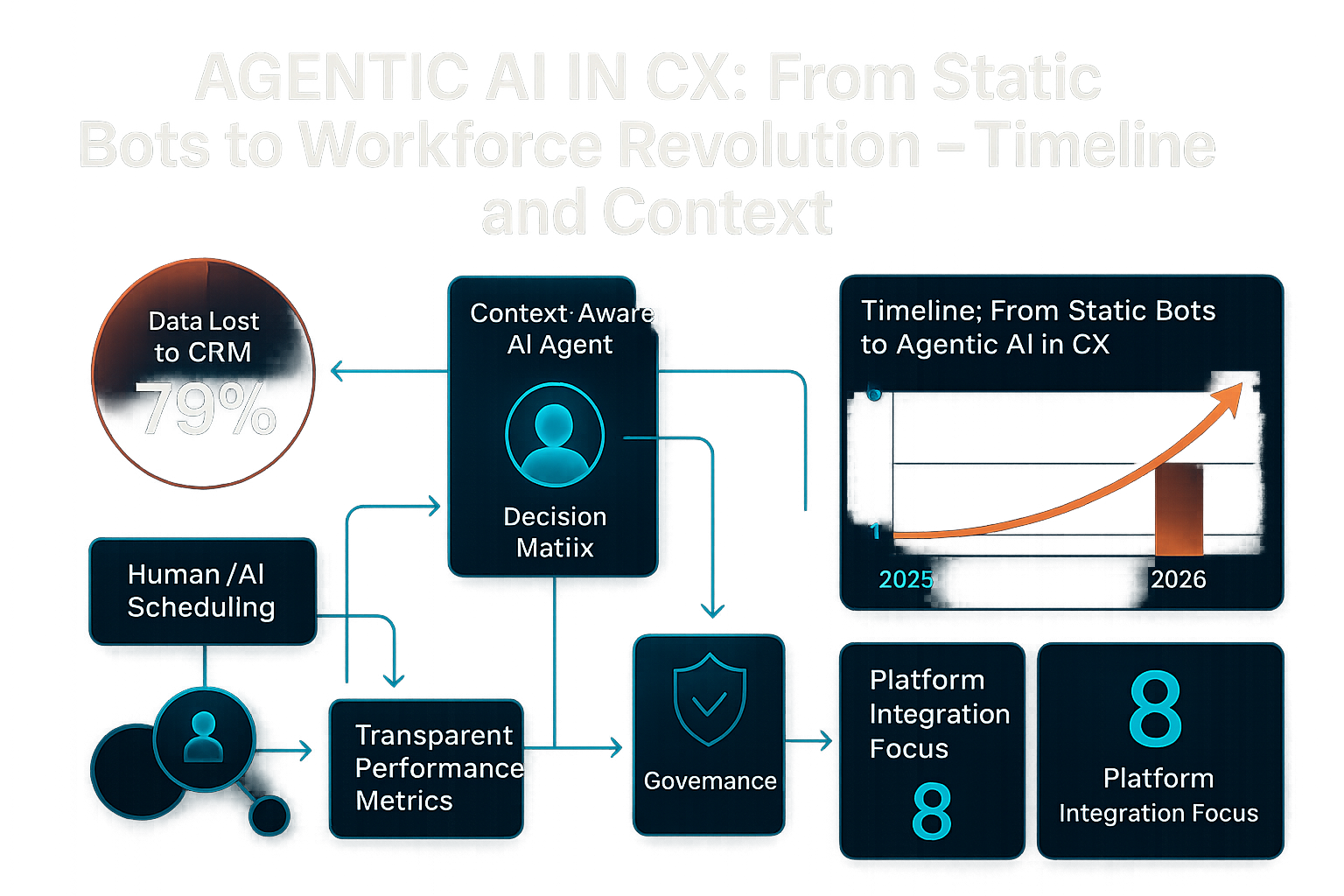
Timeline: From Static Bots to Agentic AI in CX
Platforms or launchesTimeline
- Pre-2026: Static Bots Era
Most CX automation was limited to chatbots and scripted rules, with little performance accountability or context reuse.
- June 2026: CCW Agentic AI Surge
Zoom, Salesforce, RingCentral, Dialpad, and 8×8 unveil platform-native agentic AI tools, emphasizing orchestration, workforce parity, and persistent context.
- Immediate Next Steps
Vendors race to integrate governance, audit, and explainable AI features. Enterprises begin to combine human and AI agent scheduling and performance management.
- Upcoming Review Points
Industry will watch for cross-vendor integration outcomes and operational risks in hybrid AI-human models.
Context behind Agentic AI Disrupts CX Platforms
Customer experience has long been the proving ground for conversational AI, but static bots delivered fragmented service and limited organizational impact. The shift toward agentic AI, driven by platform leaders and crystallized at events like CCW, redefines how companies structure CX operations. By natively embedding AI agents into workflow and workforce management tools, vendors promise not just new automation, but a re-architected CX operating system.
Why it matters for Agentic AI Disrupts CX Platforms
This cycle of product launches turns agentic AI into a core business operations layer rather than an add-on, requiring leaders to rethink workforce management, system integration, and CX data strategies. Inaction risks operational opacity, regulatory non-compliance, and falling behind in delivering personalized customer service.
Key data behind the update
Nearly four out of five customer signals never enter legacy CRM systems, highlighting the shift to conversation-based context.
Salesforce entered the contact center platform space less than a year ago but is rapidly closing feature gaps.
Five major vendors at CCW (Zoom, Salesforce, RingCentral, Dialpad, 8×8) launched platform-centric agentic AI CX upgrades simultaneously.
Comparison criteria
AI agents are managed, scheduled, and evaluated like human employees.
New staffing models and performance frameworks needed.Persistent memory (conversation intelligence, engagement history) is native to new CX layers.
Substantial improvement in experience continuity and agent handoff.Agents are built and governed within integrated platform tools (low-code, prompt-based).
Faster iteration and risk of governance gaps if not managed closely.Vendors compete to anchor the data ‘source of truth’ in conversation streams or CRM.
Decision shifts to architecture strategy and integration partners.Possible outcomes
Unified performance suites and low-code AI builder tools become standard in CX deployments.
Agentic AI rapidly replaces legacy static bots across industries.Inconsistent data ‘source of truth’ and audit gaps stall large-scale agentic AI rollouts.
Enterprises slow AI adoption, awaiting clearer governance patterns.Signals to watch
This would confirm industry-wide transition to hybrid managed workforces.
Shifts market focus to compliance and operational transparency.
Determines platform stickiness and CX quality edge.
Tests scalability claims and business viability of new operating models.
Deconstructing the Agentic AI Shift: How CX Operations Are Being Reengineered
From Chatbots to Agentic AI: Fast-Forwarding the Playbook
Customer experience leaders previously relied on disconnected bots that automated routine inquiries but lacked persistent memory and measurable performance. CCW 2026 marks a turning point, with five major CX platform providers launching context-driven, agentic AI upgrades.
These new platforms embed AI agents directly into workflow management, scheduling, and analytics suites, signaling a move from ad hoc automation to a new, integrated operating layer.
- Zoom: AI agents built via prompt, cross-channel and multilingual deployment.
- Salesforce: Integrated WEM for both AI and human agents, unified under Service Command Center.
- RingCentral: Workflow builder and analytics close the gap between AI trials and business outcomes.
Performance Management and Data Gravity Upside Down
A major paradigm shift is treating AI agents as workforce resources—managing quality, utilization, and adherence alongside humans. This approach surfaces new demands, such as versioning, coaching, and KPI tie-ins for every agent.
Data authority is shifting away from static CRM fields toward dynamic interaction streams, as robust, queryable context becomes the key differentiator for next-gen CX.
- Zoom and RingCentral: Emphasize multi-location, context-rich deployments.
- Dialpad: Native integration of conversation intelligence with leading AI models.
- 8×8: Real-time analytics for call routing and proactive engagement.
Governance, Integration, and the New Vendor Debate
The consolidation of agent design, governance, and performance measurement into platform-native suites means less IT development overhead but higher stakes: unclear data flows or audit trails can quickly undo CX gains.
Competition is intensifying over which stack—CRM-centric or contact-center-centric—will own the 'source of truth' and system of record for customer data and agent actions.
- Salesforce: WEM leverages existing CRM data for CX oversight.
- Other vendors: Bet on unified communications/CCaaS as core fabric.
- Key concern: Will platforms interoperate or reinforce silos?
What Comes Next: AI Workforce and Platform Integration Playbook
IT and operations leaders face new checklists: Define agent success by business KPIs, build transparent handoff protocols, and document all data sources and governance controls.
Sourcing strategies and platform selection now hinge as much on explainability and integration hooks as on raw AI capability.
- Prioritize platforms with proven audit and observability features.
- Clarify master data systems and context-sharing strategies.
- Closely tie every AI agent deployment to measurable business outcomes.