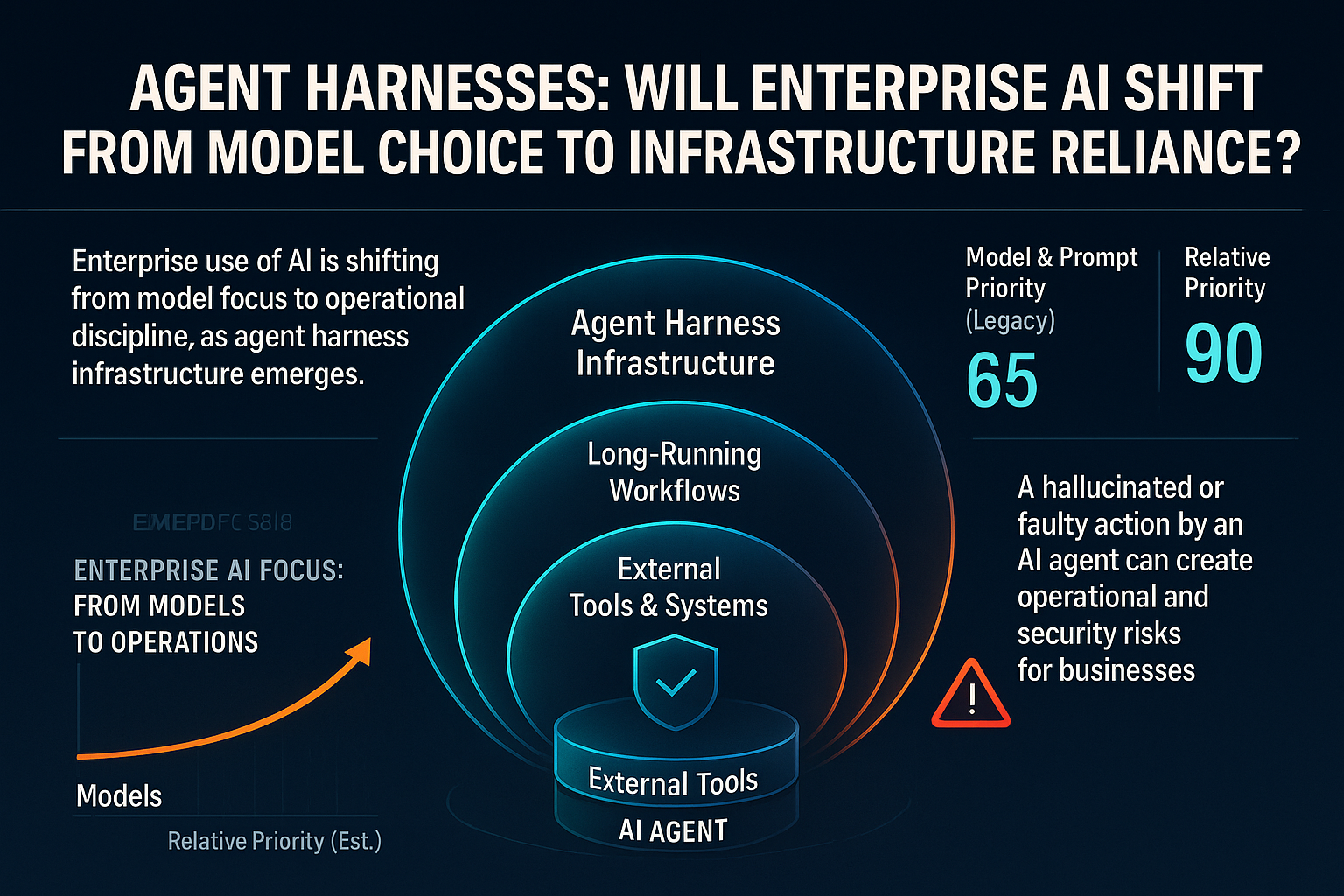
Key data behind the update
Indicates initial enterprise entry point into AI centered on model selection, not system control.
Marks a transition in what markets view as critical: from agent intelligence to agent governance.
Signals that consequences of agent decision-making in business processes are significant.
Why it matters for How Agent Harness Infrastructure Could Reshape
Enterprise adoption of agentic AI hinges on more than deploying advanced models. Without robust operational infrastructure—covering everything from auditability to multi-agent collaboration—the risks increase with system complexity. For digital systems companies, the next wave of value creation (and client trust) will come from taming unpredictable systems, enforcing organizational policies, and making AI workflows as safe as their human-managed equivalents.
Context behind How Agent Harness Infrastructure Could Reshape
Previous inflection points in digital infrastructure—containers requiring orchestration, microservices demanding service meshes—parallel the current challenge: AI agents alone are not production-ready for enterprise. Companies in the business systems space must address operational gaps before widespread AI adoption can materialize safely.
Workflow impact
- Raises the bar for vendors and systems providers: success now depends on delivering trustworthy, controllable AI operations.
- Creates potential demand for new categories of orchestration and governance platforms.
- May delay or complicate production deployment of autonomous AI until infrastructure standards emerge.
- Shifts market competitive advantage from having proprietary models to building secure, auditable execution environments.
Comparison criteria
Governing and operationalizing agents
Indicates shift towards operational safety as a market driver.Low tolerance for unpredictable agent actions
Requires higher standards and reliability mechanisms.Need for agent harnesses and policy enforcement
Promotes emergence of new systems categories.Timeline
- 2020s - Experimentation with isolated AI agents
Organizations explore chatbots and basic agent integrations, focusing on model capability.
- 2026 - Enterprises hit operational limits with agentic AI
Challenge shifts to orchestration, governance, and harnessing complex workflows.
- Next 2-3 years - Standardization needed
Widespread deployment depends on emergence of agent harness ecosystems and governance frameworks.
Signals to watch
Indicates movement from idea to actionable market solution.
Will validate infrastructure maturity and clarify integration pathways for companies.
Would strengthen the case for prioritizing operational discipline over model improvements.
Reflects changing priorities in enterprise software procurement.
The New Battleground: Agent Governance, Not Smarter Models
Why the Operational Layer Emerges Now
As agents move to long-running business workflows, failings in control or policy could break trust and cause damages. Unlike previous chatbots, these agents must interact with critical systems—and errors aren't just embarrassing, they’re costly or dangerous.
The primary pain for enterprise clients has shifted: no longer 'does my model answer well?' But 'how do I ensure safe, controlled, compliant action across sprawling workflows?'
- Decision-making by agents now directly affects operations.
- Audit trails and governance must work across distributed agent workflows.
- Integration complexity rises with multi-agent scenarios and tool interaction.
Lessons from Earlier Infrastructure Shifts
Cloud-native adoption needed containers and orchestration (like Kubernetes) to be viable for the enterprise. Microservices required service meshes for observability and policy. Each time, a supporting layer enabled safe scaling and governance.
AI agents face a similar inflection: isolated pilots may work, but broad deployment falters without strong harnesses.
- Operator confidence only grows with proven controls.
- Service outages or rogue actions quickly erode support.
- Standardized harnesses would enable broader adoption.
When (and If) the Shift Becomes Reality
The projected boom in agent harness tech is not guaranteed. For a true market shift, companies must move from experimentation to procurement, demanding vendor support for policy, audit, and observability.
Signals include increased buying criteria around operational control and clearly documented failures when controls are absent.
- Incident reporting may drive urgency for harness adoption.
- Procurement standards could crystalize market expectations.
- Early platform standards may set barriers for later rivals.